
Writing novels broke my heart. Writing games saved me.
If you’ve ever felt like a failed writer, this post is for you. Because I’ve been there. I have felt the soul-crushing burden of having my writing rejected over and over again. And this is how I turned it around. Think of it as my origin story.
Ever since I was a kid I wanted to become a full-time writer. I loved novels and I wrote from an early age. In my 20s, I started writing my own manuscripts, with the dream of being a published novelist. I took a postgraduate course in Creative Writing. I scrawled down drafts on reporters pads on the bus to work. I sent my early novels around and got one rejection from an agent. It took me ten years to send a book out again.
In 2015, I started writing novels again, and that novel got longlisted for the Debut Dagger, alongside nabbing me an agent in the US. Being the naïve writer I was, I thought publication was the next step – my book would get picked up and I’d be a novelist.
I was wrong. Getting an agent is great, but the publishing industry is still hard to crack. And this video certainly isn’t a criticism of my agents, who really, really wanted to sell my books too. But the book didn’t get picked up. I’d put my heart and soul into it, and it felt like nobody wanted it. I know that publishing isn’t personal, but it’s hard not to take these things personally when you’ve spent years on a project.
I then wrote another book, which didn’t get picked up. Writing a novel on top of a day job takes years of work, and at this point in time, I was burnt out. I felt like I’d wasted five years of my life. I hated novels. I resisted reading, the one thing I’d loved when I was a kid.
Then the pandemic happened.
Being in the world’s longest lockdown finally gave me the time to do some of the writing projects I’d always wanted to do.
I’ve always loved games – I’ve been playing them since I was a toddler – but I found the chance to make my first tabletop RPG with Storytelling Collective’s Write Your First Adventure Course. I had a gap in my writing schedule, and I thought, stuff it. I’ve always wanted to write a game. And so I did it. The challenge was to write a Call of Cthulhu one-shot over the space of a month.
I brought all the skills I had learned from writing novels to writing games. At first, it was hard shifting gears from prose writing to TTRPGs, which are a combination of literary style and technical document. You want to write a beautiful game, but you also need to make it easy for the game master to run it. I was used to having a near-unlimited word count.
In games, I had to make every word count. Instead of writing in a character’s voice, I saved those voices for handouts to convey personality to the player, and to communicate the essential clues for solving a mystery. Instead of writing a lyrical description of a building, I wrote a tight paragraph for the GM to read to the players, making every word do the heavy lifting. And I studied how other games were written, to make sure I was writing in the house style for Call of Cthulhu.
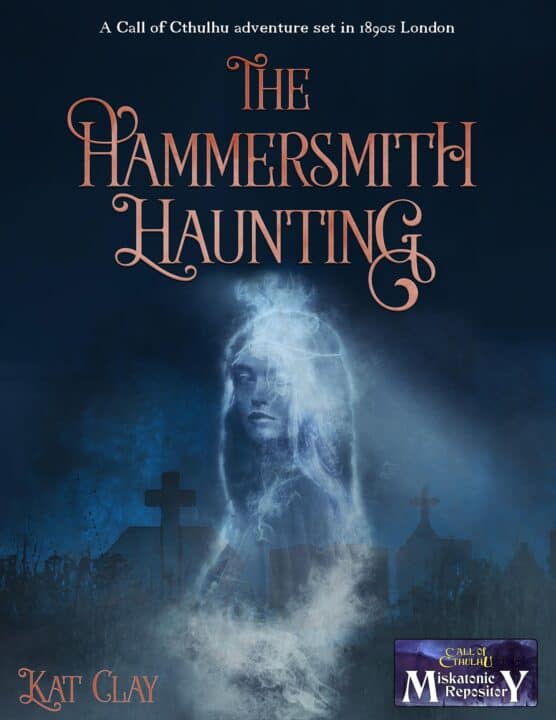
That game became The Hammersmith Haunting, a gaslight adventure for Call of Cthulhu. I released it in the expectation it would sell a few copies. Maybe my mum would buy one.
Four years later, it’s sold over 1,000 copies.
After the success of that game, it seemed like I was onto something. But it wasn’t just about sales for me. Hearing that people were playing my game around the world gave me a burst of immediate confidence in my writing. I had been longing for people to engage with my writing for years, and now they were.
I wanted to build on the success of the first game. So I wrote The Well of All Fear, a scenario for Regency Cthulhu. I wanted to do it as a portfolio piece, to show I was capable of writing something longer. It was double the size of The Hammersmith Haunting, and took around five months to write.
It ended up winning a Silver ENNIE award for Best Community Content, and was nominated against a list of professional productions for Best Adventure, Short Form. ENNIEs are some of the highest prizes in the world for tabletop roleplaying games, and here I had won one for my second game.

When I started out writing games, I never expected that kind of success. I did it because I loved games. Since those first publications, I’ve published another game, Resort, which won Best Scenario at the Australian Roleplaying Industry Awards.
I spent years writing novels, facing disappointment after disappointment. But it wasn’t until I switched to game writing that I healed as a creative. I still believe that no writing is ever wasted; those years I spent writing novels really helped me hone my craft and my capacity to produce work.
But it’s games that saved me from myself. For years, I thought I’d failed in my writing dreams.
At the end of last year I quit my job to become a full-time game writer.
You might be in the same place I was. You might be feeling like you’re a failure. You’re not. You’re just on a journey to find where you’re meant to be. There’s a myth that if you haven’t made it when you’re young, you’re not going to make it. But most writers get published in their middle-age, when they’ve got experience under their belt. If you’re struggling with writing a novel, why not try something different – a game, a comic book, a script. It might open up your creative process.
Writing TTRPGs has made me a better, more wholistic writer. I’m not ruling out a return to novel writing, but having game writing projects on the go has brought an immediate satisfaction to me that novel writing never did. I’ve learned it’s much better to have a mix of projects – some shorter, some longer – to keep you motivated as a writer. I now feel more confident in my work, and happier than I’ve ever been, because of game writing.
Now I’m freelancing for Chaosium and other clients, and I’m working on some really exciting game projects of my own. I’m still trying to sell a novel, but it’s not at the expense of my happiness – or my own vision of success.
Share your thoughts